Chapter 1 · Foundations
Adoption is not one thing
Overview
Adoption is a single word for a very wide range of experiences. Between five and seven million Americans are adoptees, and the path a person took into adoption shapes how it unfolds across their life, what questions they carry, and what shows up in your room.
Take Mother's Day. The day tends to surface relinquishment for adoptees, the plain fact that one mother didn't raise them. How that lands varies enormously, and not only by the current relationship. An adoptee in reunion with her birth mother may be managing two cards, two phone calls, and the question of how to hold two relationships in one day. An adoptee who knows her birth mother's name but has no relationship with her may be carrying anger or grief about a woman who is alive and not in her life. An adoptee whose birth mother has died is grieving a relationship she can now never have. And an adoptee with no biological information at all is sitting with the absence itself, a mother whose identity isn't available to her. Same day, four different clinical situations.
What follows are the forms counselors encounter most often. The numbers vary in quality. Some forms are tracked carefully in national data; others are barely tracked at all.
Domestic infant adoption
A child born in the same country as the adoptive parents is placed as an infant, usually within days or weeks of birth, typically through a licensed agency, an attorney, or another private intermediary. Most contemporary US domestic infant adoptions are open to some degree, meaning identifying information is shared and some ongoing contact is anticipated.
This is a substantial portion of the US adoptee population. From roughly 1945 to 1973, sometimes called the Baby Scoop Era, an estimated 20 percent of babies born to unmarried white American women were placed for adoption, and many of those adoptees are now in midlife or older. Current placements are estimated around 25,000 a year, though private domestic infant adoption is tracked less consistently than foster care adoption.
Clinically: early relational disruption between infant and birth mother; the lifelong significance of how adoption was talked about in the family; and whether the openness was actually maintained. An adoption that was legally open at placement can become closed in practice if contact simply stops over the years.
Foster-to-adopt
A child enters foster care because of abuse, neglect, parental incarceration, parental death, or other circumstances leading to termination or relinquishment of parental rights, and the foster family becomes the adoptive family. This is distinct from foster care, where the goal is reunification; in foster-to-adopt that goal has been determined to be no longer possible.
Since the Adoption and Safe Families Act of 1997 made foster care adoption a federal priority, hundreds of thousands of children have been adopted from US foster care. In FY 2024, 46,935 children were adopted from foster care, down from a peak of about 66,000 in 2019. More than 108,000 children in care are classified as eligible for adoption at any given time. This is the most consistently tracked form in national data.
Clinically: the trauma history that preceded placement; often an older age at adoption; multiple prior placements; attachment disruption; and birth family relationships that may or may not continue. Many foster-to-adopt adoptees were old enough to remember their birth families, which makes their picture different from infant placement.
Kinship adoption
A child is adopted by a biological relative or someone with an existing family connection: a grandparent, aunt, uncle, older sibling, or close family friend. It may follow a parent's death, a parent's incapacity, or removal through the child welfare system.
Kinship adoption isn't tracked consistently. Some appear inside foster care adoption totals when they run through child welfare; many don't, particularly when arranged privately within a family. Informal kinship care is even less visible. The actual proportion of US adoptions that are kinship is unknown.
Clinically: the original family is visible in the child's life, and the birth parent may be a relative they see regularly; family roles overlap when a grandmother becomes a mother; the family system has its own rules about what gets named. There's usually less geographical separation, and its own complexities around grief, roles, and identity. Lesson 6.3 develops this.
Intercountry adoption
A child born in one country is adopted by parents in another, usually after institutional or foster placement in the country of origin. Between 1999 and 2014 alone, roughly 256,000 children were adopted by US families through intercountry adoption, and earlier waves (Korea from 1953, plus Vietnam, Russia, China, Guatemala) add hundreds of thousands more to the adult population. Annual flow has collapsed: from about 23,000 in 2004 to 1,172 in FY 2024, a 95 percent drop, driven by policy changes in sending countries and restrictions following the Hague Convention.
Clinically: loss of country of origin and its culture, often combined with racial and ethnic difference from the adoptive family; questions about identity, racial belonging, and connection to a country they may not remember. The history also includes documented coercion, fraud, and falsified records, and adult intercountry adoptees are increasingly searching for accurate origin information. Lesson 6.2 develops this.
Transracial adoption
A child of one racial or ethnic background is adopted by parents of another. It cuts across all the other forms: it can occur within domestic infant adoption, foster-to-adopt, intercountry, or kinship. Historically the most common form in the US has been the adoption of Black, Latinx, or Asian children by white parents. Roughly 25 percent of currently-adopted children in the US are a different race or ethnicity than at least one adoptive parent. It isn't tracked as its own category in national data. Lesson 6.1 develops this.
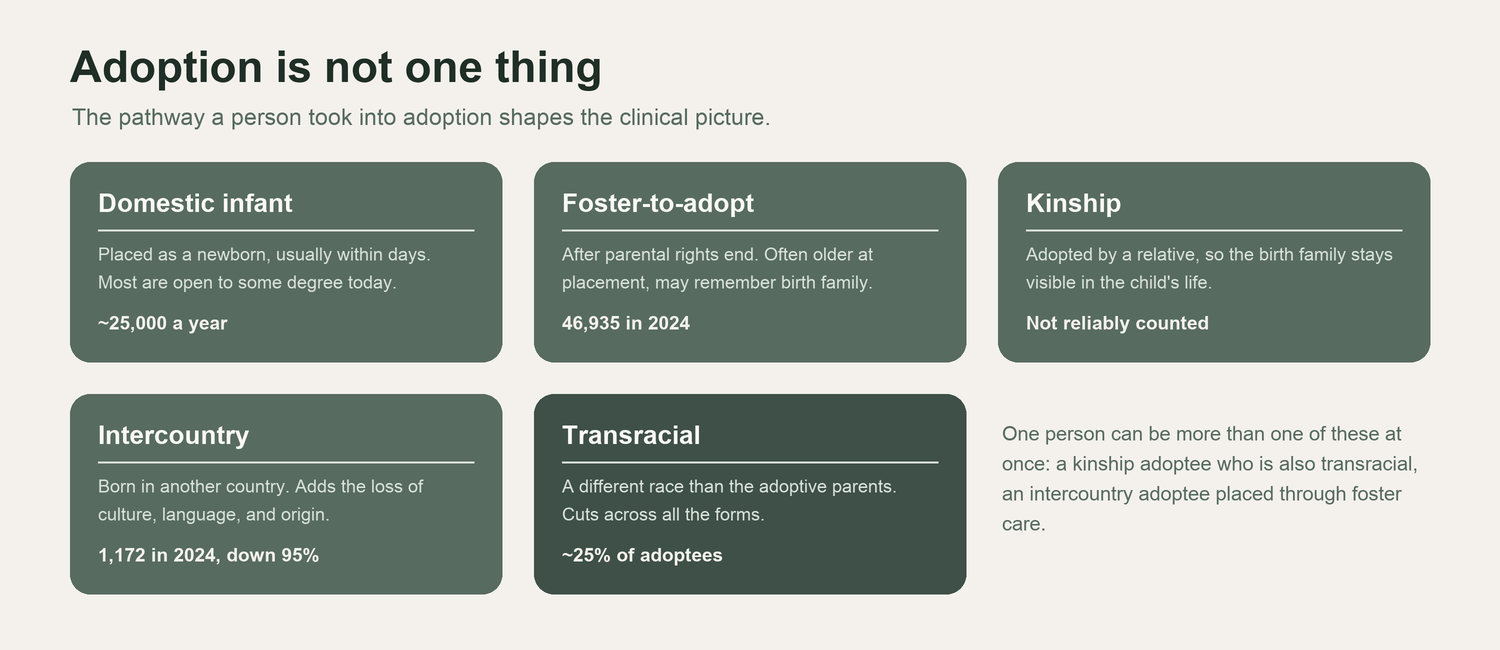
Keep — one-page takeaway
The pathway into adoption shapes the clinical picture. Use this to orient, not to categorize a client before they've told you their own story.
- Domestic infant. Placed within days or weeks, usually via agency, attorney, or intermediary. Most contemporary ones are open to some degree. ~25,000/year currently; the Baby Scoop Era (1945-1973) placed an estimated 20% of babies born to unmarried white American women, and those adoptees are now midlife or older. Watch: early relational disruption, how adoption was talked about at home, and whether openness was actually maintained in practice.
- Foster-to-adopt. Follows termination or relinquishment of parental rights; distinct from foster care, where reunification is the goal. 46,935 adopted from US foster care in FY 2024 (peak ~66,000 in 2019); 108,000+ eligible at any time. Most consistently tracked form. Watch: pre-placement trauma, older age at adoption, multiple placements, attachment disruption, continuing birth family relationships, and actual memory of birth family.
- Kinship. Adopted by a relative or existing family connection. Not consistently tracked; true proportion unknown. Watch: the original family visible in daily life, overlapping family roles, what the system names and doesn't, less geographic separation. See 6.3.
- Intercountry. ~256,000 to US families 1999-2014, plus earlier waves from Korea (1953 on), Vietnam, Russia, China, Guatemala. Annual flow down 95%, from ~23,000 (2004) to 1,172 (FY 2024), post-Hague. Watch: country and culture loss, racial difference from the family, and placement-era coercion, fraud, or falsified records. See 6.2.
- Transracial. Cuts across all the other forms rather than sitting beside them. ~25% of currently-adopted US children differ racially or ethnically from at least one adoptive parent. Not tracked as its own category. See 6.1.
The underlying point:
- Mother's Day is the same day for every adoptee and a different clinical situation for each. In reunion, knowing-but-no-relationship, birth mother deceased, and no information at all are four different rooms.
- Form shapes the questions a client carries. It doesn't tell you what they feel.
Continued considerations
- Which forms are actually represented on your caseload, and which have you never worked with?
- Where does your mental image of "an adoptee" come from, and which form is it?
- Sit with this: what do you assume about a client's story once you learn which form it was?