Orientation
Before We Begin
Watch
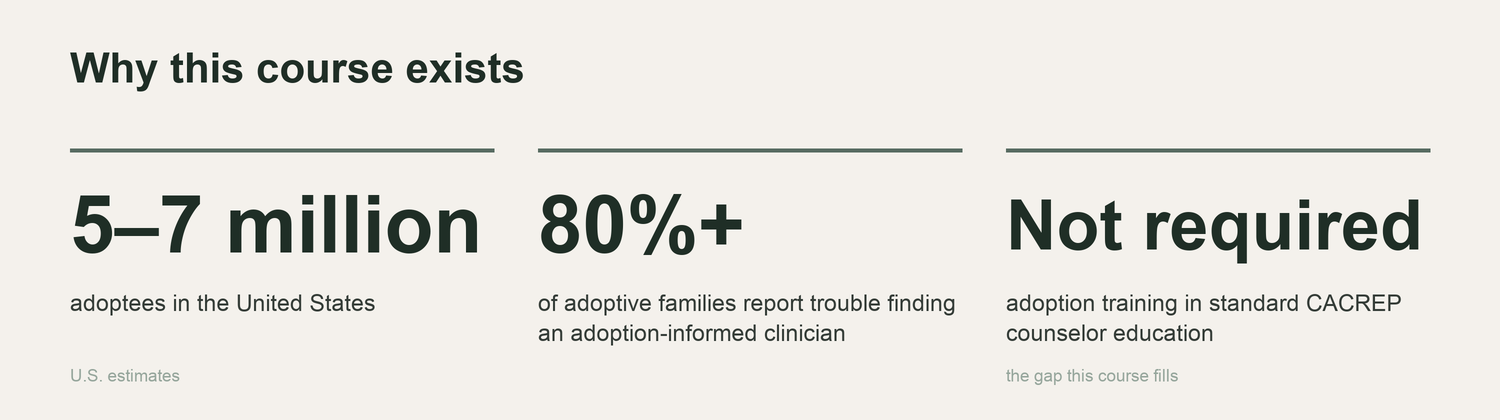
Most counselors come into this work without really thinking about adoption. It isn't that they've dismissed it; it just hasn't been on the radar as something that shapes a client's life. If a client mentions they were adopted, it's easy to take that as a fact from the past and move on. This course starts there, with the small but real shift from “they were adopted” to “oh, that matters, and it might be part of what we're working on.” Adoption is rarely taught. It isn't required in counselor education, CACREP doesn't include it, and most programs don't offer it. So a clinician can be well trained and still have an adoptee sit down across from them carrying a whole context no one prepared them to see. That gap is what this course is here to close.
Adoptees are not a small group. There are an estimated five to seven million in the United States, and many more people who have adoption somewhere in their family. In one national survey, more than eighty percent of adoptive families said they had a hard time finding a clinician who understood adoption. So you are probably already seeing adoptee clients, even if adoption hasn't come up in the room.
I could have built this as a training that just hands you terms and frameworks. There is real knowledge here that the field has left out, and we will cover it. But information was never the main thing these clients were missing. What they were missing was someone who could sit with what they carried without needing to fix it or explain it away. So this course is built to help you feel the experience from the inside and notice your own reactions, as much as to teach you what to know.
Most lessons are short and follow the same shape. You watch a short video, usually me setting something up and then an adoptee talking about it in their own words. There is a brief reflection that connects the material to something in your own life, a moment from real practice to think through, and a one-page summary to keep. Not every lesson has all of those pieces. Some are quick reference, and others are slower and more personal.
It matters who is speaking to you here. I am an adoptee myself, and the research this course is built on was done with other adult adoptees, whose words you will hear throughout. That shapes both what I can show you clearly and where I will point you toward other people's expertise instead.
Before you begin, one thing about taking care of yourself. Adoption is close to home for many people, and it may be close to home for you. Some of this material can bring up personal feelings, and the course is meant to be taken at your own pace. If you need to set a lesson down and come back to it another day, that's completely okay. The course is built to be used that way.
Welcome. Let's begin.
Review
Why this course exists: Adoption is rarely taught in counselor education (not required by CACREP, rarely offered). Yet there are an estimated 5–7 million adoptees in the U.S., and over 80% of adoptive families report difficulty finding clinicians with adoption-specific knowledge (Vandivere et al., 2009). You are likely already seeing adoptee clients.
What makes it different: It's built so you feel the adoptee experience and notice your own reactions, not just learn terms. The knowledge is here too, but felt understanding is the goal.
The format, Watch · Feel · Apply · Keep:
- Watch, a short video: an idea set up, then an adoptee in their own words.
- Feel, a brief reflection connecting the material to your own experience.
- Apply, a real in-session moment to work through.
- Keep, a one-page takeaway to return to. (Not every lesson uses all four.)
The seven chapters:
- Foundations, vocabulary, the forms adoption takes, adoption as a lifespan experience.
- Identity and self, how adoptee identity develops over the lifespan.
- Loss and grief, how loss operates in adoption and shows up clinically.
- Language and the clinical encounter, how the words counselors use shape the work.
- Clinical practice, intake, clinical response, and applied skills.
- Complexity and context, how different forms of adoption produce different clinical pictures.
- Integration and continued learning, bringing it together; the framework behind the course.
Who it's for: Licensed counselors, social workers, school counselors, and graduate trainees who will meet adoptees in their work. It is not a primer on adoption law, agency practice, or placement, and it is not designed for adoptive parents (though some material may help them).
Scope and positionality: The focus is the clinical work of being with adoptee clients; birth-parent and adoptive-parent perspectives are referents, not subjects (pointers to that literature are given where relevant). The author is an adoptee, and the course is grounded in an IPA study of 15 adult adoptees in same-race domestic adoptions, which is both its empirical strength and its limit.
Taking care of yourself: Go at your own pace. Some sections may surface personal feelings, particularly placement-era practices, late discovery, ambiguous loss, the gratitude bind, and reunion or first-time grief work. Pausing and returning is part of the design. Adoptee, birth-parent, and adoptive-parent community organizations are named in the resources sections of relevant modules.