Chapter 1 · Foundations
The Seven Core Issues
Overview
Before this course's own way of seeing adoption, it helps to start with the model most counselors meet first. The seven core issues in adoption is the most widely taught account of adoptee experience in adoption-competent practice, and if you've done any adoption training you may already know it. Deborah Silverstein and Sharon Kaplan first named the seven issues in 1982. Sharon Kaplan Roszia and Allison Davis Maxon expanded the model in 2019, across the fuller range of permanency, including foster care, kinship, and donor conception, and to account for how attachment disruption and trauma affect everyone in the adoption constellation.
The model names seven themes that recur across adoption: loss, rejection, shame and guilt, grief, identity, intimacy, and mastery or control. Two things are worth holding as you read them. They aren't a diagnosis or a developmental ladder to climb; they come and go across a lifetime, set off by ordinary events. And in the 2019 expansion they belong to everyone in the constellation, so birth parents and adoptive parents carry their own versions. What follows describes them as they tend to show up for adoptees, which is where this course sits.
Loss. Every adoption begins with a separation, and loss is the ground the other six rest on. It is a particular kind of loss: often unremembered, because it happened so early; rarely marked by anyone, because the culture doesn't count it as a loss; and never fully closed, because the birth family exists somewhere. For many adoptees it sits in the background for years and comes forward at specific moments rather than staying constant.
Rejection. The original loss can be experienced as having been rejected, whatever the actual circumstances were. That can leave a person primed to expect rejection elsewhere, and the protective response takes different shapes: avoiding situations where rejection is possible, reading it into small cues, or ending things first. It often looks like sensitivity out of proportion to the moment, until you know what it's organized around.
Shame and guilt. Related, and worth keeping distinct. Shame is the sense of being defective, that something about me is the reason I wasn't kept. Guilt is about having done something: feeling responsible for the relinquishment, or feeling disloyal to adoptive parents for having questions about the birth family. Both tend to go unspoken, and both can hide inside presentations that read as low self-worth or chronic over-responsibility.
Grief. The losses call for grief, but adoption grief is usually disenfranchised, with little social permission to name it, and it often couldn't be grieved when it happened because the adoptee was too young. So it gets deferred, and surfaces later, sometimes decades later, looking larger than whatever set it off.
Identity. Adoption complicates the ordinary work of figuring out who you are, because some of the raw material is missing or uncertain, from medical history to ancestry to cultural background. The questions sharpen in adolescence and return at later thresholds. This is where “where do I come from” and “who do I belong to” live.
Intimacy. The first four issues can make closeness hard. If closeness once ended in loss, deep trust can feel dangerous, so a person may hold something back even in relationships they want and value. It shows up as trouble fully letting people in, a wall that coexists with real love, or a pull to leave before being left.
Mastery and control. The defining events of an adoptee's early life, relinquishment and placement, happened without any say from them, at an age before they could have had any. That can produce a strong need to control whatever can be controlled, or the opposite, a background sense of helplessness. Watch for the client who falls apart when plans change, or who has organized a whole life around never being caught unprepared.
This course builds on the seven core issues rather than replacing them. They are a reliable map of what comes up in adoption. What they don't do on their own is tell you when a theme will surface for a particular person, why it weighs on some adoptees far more than others, or how it shifts across a life, and that is the work the later chapters take up. Hold the map loosely: not every adoptee carries every theme, and it is for recognizing what you hear, not for sorting a client into a category.
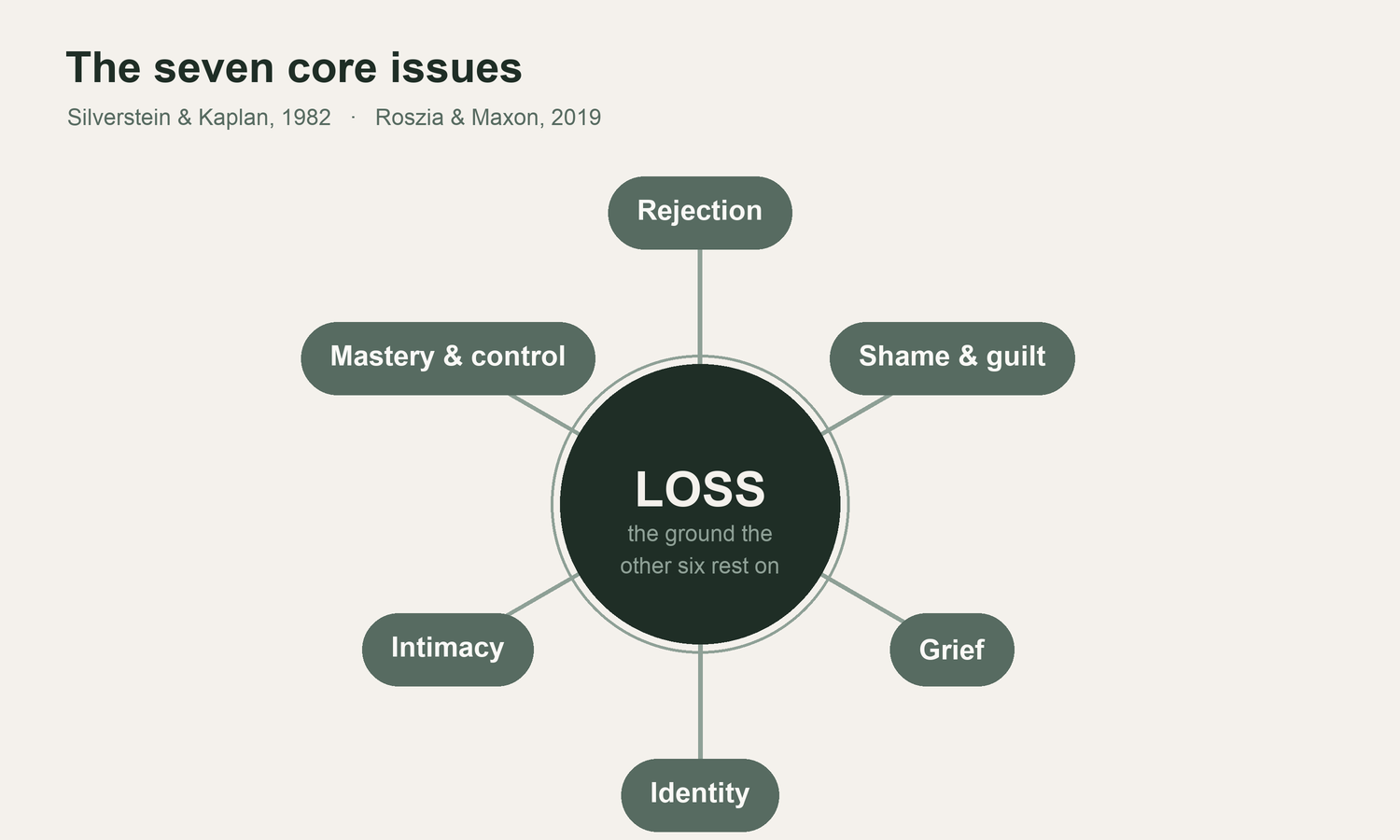
Keep — one-page takeaway
The field's shared map (Silverstein & Kaplan, 1982; expanded by Roszia & Maxon, 2019): seven themes that recur across adoption, for everyone in the constellation, across the lifespan. This is what each one tends to look like in the room.
- Loss — the ground under the other six. Often unmarked and unresolved; listen for it underneath depression, anxiety, and relationship patterns.
- Rejection — expecting to be left. Sensitivity that seems out of proportion; avoiding, provoking, or pre-empting rejection.
- Shame and guilt — “something is wrong with me” (shame) and “it was my fault, or I'm disloyal for wondering” (guilt). Often looks like low self-worth or over-responsibility.
- Grief — disenfranchised and often delayed. A reaction far bigger than its trigger is frequently old grief surfacing.
- Identity — missing biological, medical, and cultural pieces. Sharpest in adolescence and at later thresholds.
- Intimacy — a guardedness that coexists with real love; trouble fully letting people in; leaving before being left.
- Mastery and control — needing to manage everything, or a sense of helplessness. Falling apart when plans change.
Two reminders:
- These recur and cycle across a life. They aren't stages to finish or a diagnosis to assign.
- Hold the map loosely. It's for recognizing what you hear, not for putting a client in a box.
Continued considerations:
- Which of the seven do you recognize fastest, and which do you tend to miss?
- Take a current adopted client: which themes are active now, and what set them off?
- The 2019 model puts these on birth and adoptive parents too. Where might that change how you see a whole family?